Process cancellations and post-processing with cashless transactions
In the catering industry, it is completely normal for transactions to have to be processed retrospectively - for example, because guests change the payment type, receipts need to be split or the request for card payment is only expressed later. However, this is precisely where risks arise if payment terminals are not connected to the POS system or if operators carry out processes incorrectly.
If the payment method is corrected manually at the POS, even though a card-based payment was originally intended, this can lead to a loss of payment authorisation:
-
missing assignments between table, operator and payment
-
incomplete tip records
-
Inconsistencies between terminal and cash register
-
Data that is difficult to understand during an audit
Particularly critical:
A cashless payment after the end of the day or without a correct connection to the POS can impair complete documentation. This does not automatically mean misbehaviour - but it can lead to queries that can be unpleasant. Tips in particular are sensitive in this respect: they must be demonstrably paid directly by the guest to the employee in order to remain tax-free. Without a clear allocation between payment, table and operator, there is a risk that this tax exemption will be called into question.
Best practice: Correctly carry out payment corrections and cancellations for cashless payments
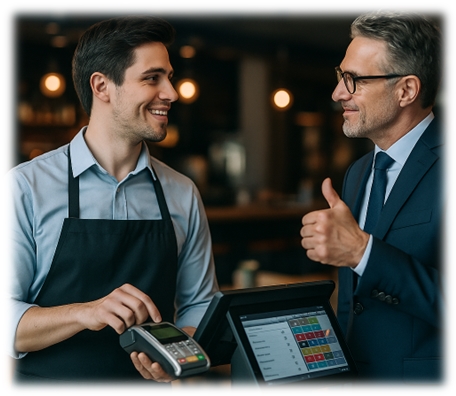
Why integrated payment terminals are indispensable
When the POS and payment terminal communicate with each other, all processes:
-
automatically synchronised
-
correctly booked
-
clearly assigned to table and operator
-
cleanly documented for tax purposes
This largely eliminates the need for incorrect manual reworking.
In companies without integration, on the other hand, a great deal depends on the operator - and this increases the risk of errors in the operating process and in the documentation.
Best practice: Correctly cancelling card payments
A common mistake: Operators cancel card payments directly at the terminal, even though the terminal is actually connected to the cash register. This leads to missing data that no longer fit together in the end.
That is correct:
Always carry out cancellations in POS, mPOS or PayPOS. The POS automatically triggers the appropriate action at the terminal. Depending on the terminal, it may be necessary to scan the guest's card again (instructions appear on the terminal display). Operators should be clearly trained in these procedures. Not every terminal can completely prevent such operating errors - which is why training is crucial.
Subsequent cashless payment for transactions that have already been completed
If a transaction was (inadvertently) completed in cash, but the guest wants to pay cashless, there are safe ways to do so:
-
Open process
-
Edit processes
-
Select change payment method
-
have cashless payment properly executed at the terminal
This means that payment methods remain traceable and correctly documented.
The following functions can provide additional support for complex processes:
-
Form enquiry for document types
They ensure that each transaction is completed with the correct document type and the correct payment method.
Conclusion
Clean, traceable documentation of cashless payments is indispensable today - not only for controlling, but also for reliable, audit-proof accounting. With integrated payment terminals and clear processes, you ensure
correct data
clear assignment
error-free tip allocation
fast traceability for queries
professional, safe operation
Used correctly, these best practices protect you, your employees and your company.
Back to the overarching topic: Payment terminals with the POS