Payment terminals in emergency operation
Payment terminals in the event of an incident - classification and risks
When payment terminals fail, this is always a serious problem for the business. Guests are then often forced to organise cash or forego payment altogether. This not only affects sales, but also the guest experience considerably.
In this context, please also read Technical and commercial risks.
(The following examples do not apply to payment terminals that are explicitly intended by Hypersoft for operation with a SIM/GSM card)
The widespread misconception: GSM in the terminal as an emergency solution
In emergencies, a concept is often used in which payment terminals are also equipped with a SIM or GSM card. The idea behind it sounds plausible at first:
If the WLAN fails, the terminal should automatically establish a connection to the data centre via the mobile network.
Accordingly, many appliances offer three operating modes:
-
Connection via WLAN (standard)
-
Connection via SIM / GSM
Automatic switchover to GSM in the event of WLAN faults (often mistakenly thought of as emergency operation)
However, what is usually not taken into account is the cash register connection.
Why GSM in the terminal is not a real emergency operation
With connected payment terminals, communication takes place on two tracks:
-
with the POS system (local, usually via WLAN or LAN)
-
with the computer centre (via Internet access)
The WLAN connection is the only compatible standard that allows both communication channels to function simultaneously.
If the terminal is manually switched to GSM, it can still reach the computer centre - but the connection to the cash register is interrupted.
The payment can then no longer be correctly confirmed or assigned to the transaction.
Even more critical is the automatic switchover in the event of WLAN interference:
-
Even short, otherwise unproblematic interruptions can cause the terminal to switch to GSM and abruptly lose the previously stable connection to the cash register. The result is cancelled payments, unclear payment statuses and considerable annoyance in ongoing operations.
Emergency operation with terminal GSM - only with clear rules
Emergency operation via GSM is possible, but only under clearly defined conditions. To do this, the cash register connection must be deliberately deactivated in the payment terminal menu.
In this case, the checkout should have a separate finalisation button that the operator can use to complete the transaction without cash.
Tips, payment cancellations or invoice splits must then be processed manually.
This emergency operation is not a spontaneous improvisation scenario. He must first:
-
be trained or at least explained
-
be backed up with clear emergency instructions for employees
Best practice: Protection via the Internet connection - not via the terminal
The most reliable and professional solution is not in the payment terminal, but at the point where your business is connected to the Internet.
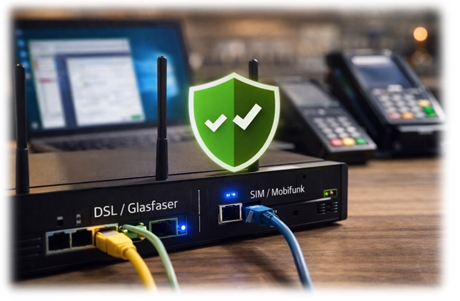
Recommended procedure
Use a router that:
-
is primarily connected via DSL / fibre optics
-
also has an integrated GSM/mobile phone connection
-
switches automatically and stably to mobile communications if the landline connection fails
This means that all connected systems - cash registers, payment terminals, servers - remain in the same network.
You only need a single mobile phone card instead of many individual ones in end devices.
In emergency operation, it is also advisable to avoid unnecessary mains loads. This includes, in particular, temporarily deactivating guest Wi-Fi in order to secure the available bandwidth for operationally relevant systems.
Conclusion
A stable payment system is not created by spontaneous switching at the terminal, but by a clean network architecture.
If you secure the Internet connection of the entire site, you protect yourself:
-
the payment process
-
cash register integration
-
the service staff
-
and ultimately guest satisfaction
Emergency operation is not a feature - it is preparation.
Further topics: Directory: Best Practice
Payment terminals with the POSBack to the overarching topic: