Management of user rights in practice
Professional processes need clear roles - even at the checkout.
Not every action may be carried out by every operator - whether for safety reasons, tax regulations or simply to correctly map responsibility.
That's why Hypersoft offers several powerful functions that allow managers to intervene in a targeted manner - without losing transparency or evaluation accuracy.
This best practice module shows two tried and tested tools from practice:
-
Working as an operator - for targeted corrections with maximum control
-
Phantom mode - for spontaneous support in live operation
Both functions fulfil different purposes - but together they enable active, flexible and transparent management of user rights in everyday catering operations.
Under this heading we would like to highlight two related and special possibilities out of the many available methods.
As a manager or executive who does not normally work as a checkout operator, it may be necessary to intervene in the checkout process. For this purpose, they can, like any other operator, receive an operator login with special authorisations and a key. But there is much more...
Best practice: Working as an operator - targeted corrections with a system
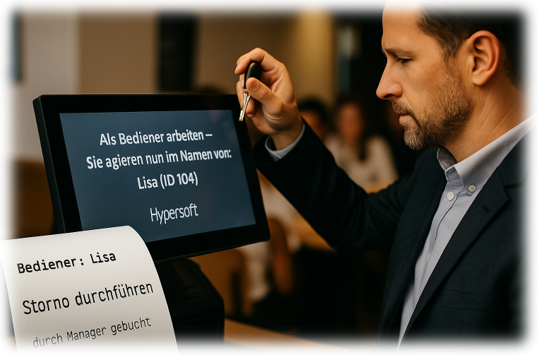
When only you are allowed to do something - but someone else should remain responsible. In practice, there are situations in which you as a manager must intervene:
-
cancel a booking for which a receipt or invoice has already been generated
-
correct a turnover that actually belongs to another employee
-
cancel an incorrect invoice without the evaluation looking as if you had achieved the turnover
This is exactly what the checkout function is for: working as an operator
What is "working as an operator"?
With this function, you temporarily take over the user ID of another employee, but retain your own rights (e.g. manager status or cancellation after completion).
Result: You intervene correctly - and yet the responsibility and turnover remain with the original operator.
Typical application scenarios
| Situation | Without function | Work with As operator |
|---|---|---|
| Manager cancels an operator's invoice | Cancellation goes to the manager | Cancellation remains with the operator |
| Operator forgets completion | Manager completes process → Sales change | Conclusion under operator identification of the original employee |
| Correction of processes from previous shift | (Not possible without rights) | Possible with manager rights, but on behalf of the operator |
| Manager posts tips for operators | Tips go to the manager | Tip remains with the operator |
How it works
In checkout mode, select the function Work as operator
A list of all operators who were active on this day appears
→ Alternatively, you can also enter their number (e.g. from the dispensing system)
You will remain logged in with your own rights, but the following actions will be:
assigned to the selected operator in receipts, reports and analyses
labelled as a "ghost booking" in the transaction details
Ghost bookings - 100 % transparent
All bookings in Work as operator mode are made separately recognisable in the accounts and in the Report Manager:
-
Operator name = original operator
-
Note: booked by manager (ghost)
-
This type can be traced at any time in the transaction details; you can have this type printed separately in the operator statements. View Ghost Booking Details
Rights & requirements
| Setting | Meaning |
|---|---|
|
Manager status active |
Mandatory for access to this function |
| No separate authorisation required | Function is included in the manager package |
| Only possible with active operators | Only employees with /TTA entry |
Why this function is important
-
Prevents incorrect sales allocations
-
Maintains accountability within the team
-
Allows managers to help without distorting
-
Supports clear analyses and a fair tipping system
Best practice: Phantom mode - spontaneous support without taking control
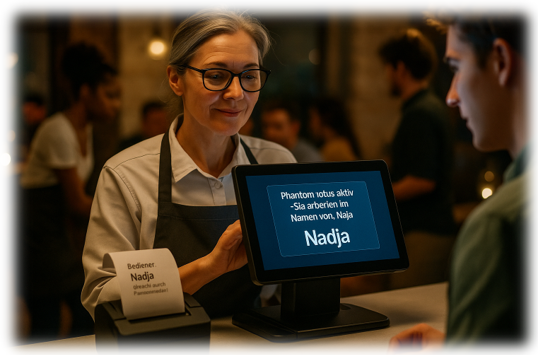
If the boss lends a hand, the turnover should stay with the team.
It's Saturday, 7.30 pm. The shop is buzzing, the operators have their hands full. Now is not the time to discuss authorisations - now it just has to work!
And this is exactly where the phantom mode comes into play. This allows managers or authorised employees to intervene spontaneously in existing processes, take orders or adjust payments without taking over the process.
What is the phantom mode?
The phantom mode makes it possible to process other users' transactions without these being transferred to the helping user's receipt or billing. The system treats the bookings as if the original operator had made them themselves - ideal for temporary staff, assistants or emergencies.
Typical use cases
| Situation Without phantom mode | With phantom mode |
|---|---|
| Boss has to help spontaneously at the table Booking appears under boss | Booking appears under original operator |
| Guest pays for wrong operator Turnover ends up with the wrong person | System specifically asks: Take over turnover? |
| Operator goes on break / is overloaded Sales increase with intervention | Process remains with the original operator |
| Temporary help for larger groups Confusion with receipt collections | Original user name still appears |
Change payments in the phantom mode...
In the phantom mode, you can change payments of an operation for yourself or others. When changing payments from other operators, the question is asked whether the turnover should be transferred (to the currently logged in operator) or whether the turnover should remain with the operator who originally settled the transaction.
How the phantom mode works
-
Register as a manager
-
Activate the phantom mode checkout function on the keypad (or set authorisation for automatic phantom mode)
-
→ You remain logged in as a user, but act "invisibly"
-
-
Processing of existing processes possible:
-
Bookings
-
Change payment methods
-
Prepare financial statements
-
-
System asks when completing a process:
-
"Book sales on you?"
-
Yes → Turnover is taken over
-
No → Revenue remains with the original operator
-
-
When creating new processes, the system asks:
-
"Who should be given process responsibility?"
-
What does this mean in practice?
-
The receipts and reports still show the original user name
-
Your interventions are traceable in the background (ghost bookings)
-
Transparency in operator billing is maintained
-
Misunderstandings about tips, turnover or statistics are avoided
Authorisations
Activation via cash register function phantom mode
Rights individually assignable (not only for managers): entrance
Fine-grained control possible:
-
e.g. only booking, but no payment allowed (prohibition: Graduation forbidden...
Phantom mode vs. "access to all tables"
| Function |
Behaviour in the POS system |
|---|---|
| Access to all tables | Assumes full responsibility during the procedure |
| Phantom mode | Helps in the background without taking over the process |
Conclusion
The phantom mode is the invisibility cloak for managers.
They help out - but leave the responsibility and recognition to the team. And that makes it the ideal solution for stressful moments and a fair billing system.
Phantom mode on mPOS and Clou Mobile
The phantom mode is also available for mobile use with mPOS or Clou Mobile - intuitively embedded in the touch interface, but with the same range of functions as at the stationary POS.
Activation on the mPOS
As soon as a user has the corresponding authorisation for the phantom mode, an additional function appears next to the logout button:
The phantom mode is activated by pressing and holding the logout symbol
The screen then clearly shows the status:
"Phantom mode active - you are working on behalf of: [operator name]"
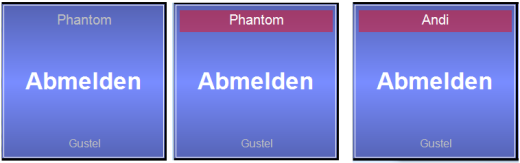
On the left "Gustel" the phantom mode is offered. In the middle the Phantom mode is already active. On the right, Gustel has completed a process for Andi.
Operator guidance in phantom mode
The same rules apply on mobile devices as on stationary checkout terminals:
When a new process is created, the system asks which operator should be given responsibility for the process
When finalising a transaction or changing a payment, the familiar query about transferring sales appears
This maintains transparency - regardless of the device or location used.
Conclusion: clear & correct even on the move
Phantom mode is not only intended for the main cash register - it is a fully integrated tool that can also be used intuitively and securely on the mPOS.
With just a few taps, managers or experienced operators can provide mobile support without system boundaries - and this strengthens your team where it counts: in contact with guests.
Further topics:
Labelling of phantom stock and working as...
Back to the overarching topic: Operator authorizations