Noteworthy facts about the staff

Due to special requirements for storing data related to time recording or employee payroll, some information is stored historically and is available in the Staff Basicssection.
What data is thus available...
Due to special requirements for storing data related to time recording or employee payroll, some of the changes are stored historically. This concerns the following information:
- Personnel Number
- Name, first name
- Unavailable working days
- Calculation basis for planning
- Theoretical hourly wage
- Hours per working day
- Flat rate hours per month
- Number of non-working days
If changes are made, all the fields mentioned are stored under the previous month. Thus, a change is valid from the current month.
Use historical data...
Changes to employee data are saved historically.

If you choose Without History - the employee master data is "normally saved" and there is no time-dependent storage of the data in the tab Fundamentals. This is sufficient for applications without wage programs or wage export in most cases.
If you select current data, changes are saved historically. A change in the current month leads to an entry for the previous month.
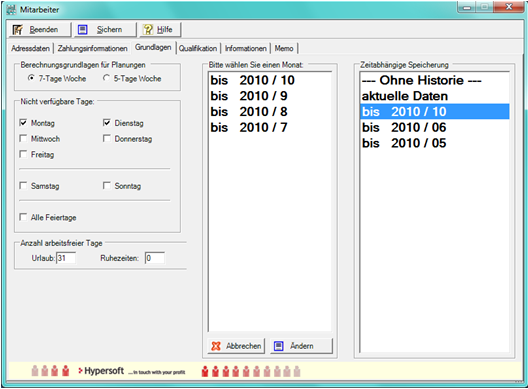
If a month is selected, the data for the selected month can be viewed and changed. To do this, right-click on a monthly entry in the list and select Changevalidity. All saved changes with the respective month are displayed. This special storage only concerns the data from the register Fundamentals.
You can now select a month for which the desired change was valid. A change is always possible from the current date to the last change.
Here in the example from07/2010 to 10/2010.
Best practice: Using theoretical hourly wages 1 and 2 correctly

Personnel costs are one of the key control variables in the catering business. Cost of goods sold can be optimised, but sales fluctuate. Personnel costs have a direct impact on operating results, so it is essential that hourly costs are recorded completely and realistically.
Why "theoretical" hourly wage?
The term "theoretical" does not mean inaccurate – it means fully calculated. In many companies, only the agreed gross wage is taken into account. However, the following is crucial for business management:
-
employer contributions
-
levies
-
non-wage labour costs
-
any additional personnel costs
Example:
Agreed hourly wage: €15.00
Actual hourly operating costs: e.g. £19.65
Only this complete value allows for a realistic assessment:
-
in the duty roster (duty roster report in the Report Manager)
-
in personnel cost ratios
-
in contribution margin considerations
Anyone who only enters the gross salary here systematically underestimates their actual personnel costs.
Why two hourly wage fields?
The separation allows for two different levels of consideration:
Hourly wage 1 – operational planning
For standardised calculations, e.g. in duty scheduling. Here, average values per function can be used (e.g. service, kitchen, bar).
Hourly wage 2 – individual cost reality
For the accurate representation of the actual personnel costs of individual employees. This information can be handled sensitively (for example, the planning employee can assume the same costs for all service employees, and you can handle the actual differing hourly wages of individuals separately). Alternatively, two different calculation models can be stored:
-
gross salary
-
Gross salary including ancillary costs
This makes the system flexible in its application, depending on the evaluation objective. Significance for planning and live controlling.
The theoretical wage costs are already calculated during the planning stage in the duty roster. This means that personnel deployment is managed not only organisationally, but also economically.
In the time recording report, selecting hourly wage 1 or 2 determines which cost basis is transferred to reporting.
This means that the quality of the evaluation depends directly on the quality of the hourly costs stored.
Entrepreneurial core
Staff deployment without a complete cost basis is not sufficient planning. The Theoretical hourly wage makes resource planning an economic decision. Only with realistic hourly costs can the following questions be answered:
-
Is the shift economically viable?
-
What level of sales performance is required?
-
What is the impact of overtime?
-
What is the actual quota?
Recommendation
Enter a fully calculated hourly cost rate for each employee. Make a conscious decision about which cost basis to use for which evaluation. Only then does time recording become business management.
You can make various settings in the employee time recording report. By selecting hourly wage 1 or 2, you influence the data that is then sent to the live report.
Further topics: Directory: Best Practice
Employee data that are not active employees
When you create employee data, you can select one of the following types, which has different effects:
- staff
- operator template
- operator function
- suitors
- Other
Type of employee...
In the standard system, you create all employees with the type Employee. In the duty roster and time recording, all employees who are not of the employee type are hidden.
Type Operator template...
The operator template is intended for operator authorisations. For example, you create employee data with the name Service Employee and assign the type Operator Template. In the operator permissions, you set the permissions for this template and then simply assign this template to the service employees so that you do not have to set permissions per employee. The number of templates is arbitrary. The structure and possibilities of the authorisation hierarchy are described in the section Creating a template for operator permissions. An operator template cannot be selected as an employee in the ward management and does not appear in time recording and duty roster.
Type Operator function...
For special situations and devices, such as the eSolutions Self-Order Kiosk (SOT), operators must also be assigned. However, since the SOT does not have an operator working from you, you can create one or more labels and assign them to the Operator Function type. Operator functions do not appear in time recording and duty roster.
All SOT bookings can then also be evaluated with the possibilities that operator reports provide.
Type of applicant...
The applicant type is simply used for differentiation and allows you to enter applicants already in the employee master record (there are otherwise no special functions for applications). An applicant cannot be selected as a staff member in the ward administration and does not appear in time recording and duty roster.
Type Other...
The Other type is at your disposal. This type can also be selected as a staff member in the ward setting. It does not appear in the time recording and duty roster.
Delete employee data
When deleting (inactivating) an employee, the image and any fingerprint data (biometrics) are deleted with immediate effect.
Export employee data
It is possible to automatically export some of the employee data together with the journal export.
Further topics: Consider employee information (when exporting)
Back to the overarching topic: employee pool